
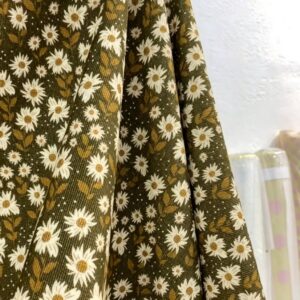
Corduroy Samples: Mark Print Face and Direction
For a printed corduroy sample, agree which side is the intended face and mark the direction used for the approval photograph. Link those marks to an identified physical swatch and ask the supplier to confirm any directional requirement separately. Jinbu Mitextile’s Cotton corduroy category uses a floral fabric reference that can begin a pattern inquiry. The category name and photograph do not by themselves verify composition, pile characteristics or the exact fabric version available for the order.
An attractive pattern photograph still needs a reference frame
A swatch can be turned, folded or photographed from another side without the image making the change obvious. Procurement may approve one view while a sample-making team receives another. Start the review by naming the supplier’s offered fabric reference and identifying the intended face on the actual swatch. Keep a full view of that identified swatch with any close pattern photograph.
Add a direction marker that both parties understand. It may point toward an identified edge or toward a direction defined in the supplier’s sample record. The important point is a shared reference, not a particular marking method. Do not assume that the top of an emailed image corresponds to the top of a fabric roll, or that the way the swatch hangs in a styled photograph defines its intended use.
Separate face approval from orientation approval
The front-facing appearance and the direction of the pattern are related but different decisions. Record them independently so that a supplier can answer an unresolved direction question without reopening a clearly identified face reference.
Reference field | What the buyer identifies | What the supplier confirms
Fabric identity | Selected category and requested variant | Offered product or swatch code
Intended face | Marked side of the physical sample | Whether that is the offered face
Reverse view | Corresponding view of the same swatch | Any relevant difference in the supply description
Image direction | Marker visible in the approval photograph | Relationship to the supplied fabric
Pattern direction | Buyer layout question | Any applicable directional requirement
Repeat reference | Whether the buyer needs repeat information | Applicable pattern reference, if offered
Ask a precise question about the floral reference
The floral image associated with Jinbu Mitextile’s category can help the supplier understand which appearance attracted the buyer’s interest. Include that reference with the inquiry and ask which fabric version it represents. Request the offered sample identifier before transferring the pattern into a product brief. A familiar category label should not silently substitute for an exact variant description.
For a floral design, the buyer may want to know whether rotating a cut piece would change the intended appearance. Ask that question directly instead of judging the answer from the visible flowers alone. If the design has no required direction for the buyer’s proposed layout, ask the supplier to state that basis clearly. Keep any separate information about surface direction or pile with its own confirmation.
Keep colour viewing and direction viewing distinct
A photograph taken under different light can change the apparent colour or surface appearance, which can distract reviewers from the orientation question. Use a clearly identified face and direction when discussing each view. If colour approval is also needed, give it its own reference and viewing agreement. Do not treat a screen image as a complete physical colour standard merely because the direction marker is clear.
Likewise, a change in apparent surface shading does not prove a composition, finish or performance difference. Describe what the reviewer observes and ask the supplier to explain the relevant offered construction. Material labels, directional handling instructions and textile properties need applicable supplier confirmation. A print-face approval should not imply that those separate requirements have all been accepted.
Give the cutting or sampling team the same information
Once the intended face and direction are agreed, carry the marked swatch reference into the sample-making brief. The team should be able to identify the same side without searching through earlier messages. Include any confirmed pattern-direction requirement and leave unanswered construction questions visible. If a garment or home-textile sample uses several pieces, the buyer can then discuss the intended relationship between their patterns using one shared reference.
Do not write that a design matches across pieces unless that requirement has been defined and accepted. Matching, placement and orientation are different questions. A supplier can confirm the intended face without agreeing to a particular motif placement on a finished item. Identify each additional requirement explicitly before it enters the purchase specification.
Handle a revised pattern as a new comparison
If the offered floral version or fabric construction changes, retain the original marked reference and label the proposed replacement separately. Compare the affected face, direction and pattern fields before accepting the revision. On a repeat inquiry, send the agreed sample code and ask whether the same reference remains applicable. An unchanged category photograph is useful for identification but does not confirm every detail of a later offer.
• Mark the intended face on an identified physical swatch.
• Keep an orientation marker visible in the approval view.
• Ask separately about print, surface and cutting-direction requirements.
• Carry the agreed reference into the sample brief and any revision review.
Frequently asked questions
Does the category photograph prove that the surface has a particular pile?
No. Ask the supplier to identify the offered fabric construction. The photograph is a catalogue appearance reference, not independent verification of pile or composition.
Is print direction the same as motif placement?
No. Direction identifies an orientation, while placement concerns where a motif appears on a piece. Define any placement requirement separately.
What if the fabric has no required pattern direction?
Ask the supplier to confirm that basis for the identified offer. Do not assume it from a small or folded product photograph.
Can a marked photograph replace the physical colour sample?
It can clarify face and direction, but any colour approval needs its own agreed reference and viewing basis.
Product and contact references
Jinbu Mitextile cotton corduroy category: https://jinbumitextile.com/products/?product_filter=%e5%85%a8%e6%a3%89%e7%81%af%e8%8a%af%e7%bb%92
Jinbu Mitextile product catalogue: https://jinbumitextile.com/products/
Contact Jinbu Mitextile: https://jinbumitextile.com/contact/
Jinbu Mitextile blog: https://jinbumitextile.com/blog/